Science, analysis app
Supernova Analyzer
- Research project
A scientific analysis app for light curves, SALT3 fits, and descriptive catalog residuals.
Code on GitHub: hyh4867/supernova-analyzer ↗
The question
Can the app recover injected light-curve parameters, and can its catalog results be reproduced independently from raw public files?
What I built
I built Basic and Scientific workflows for light-curve analysis, SALT3 fitting, residual diagnostics, and downloadable summaries.
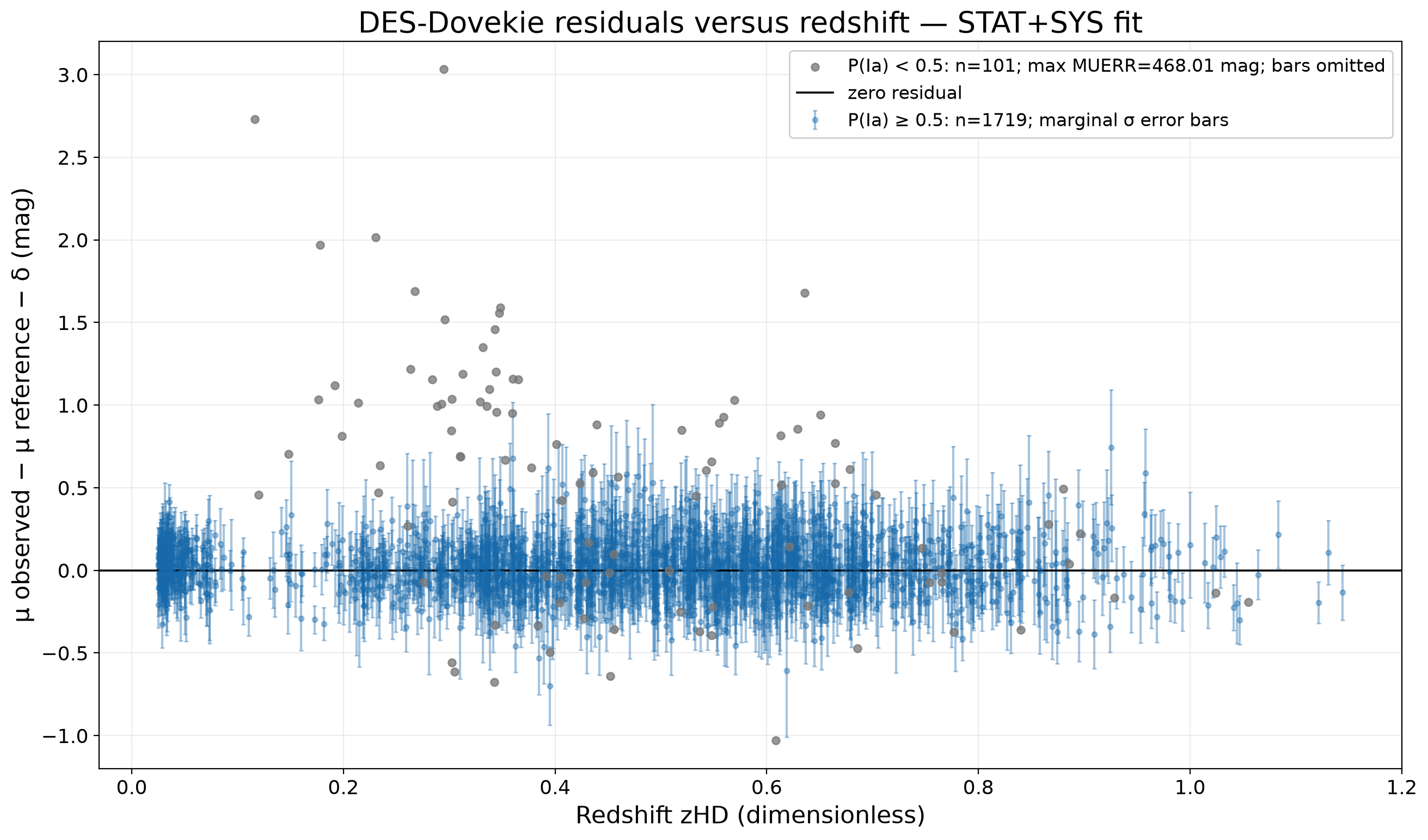
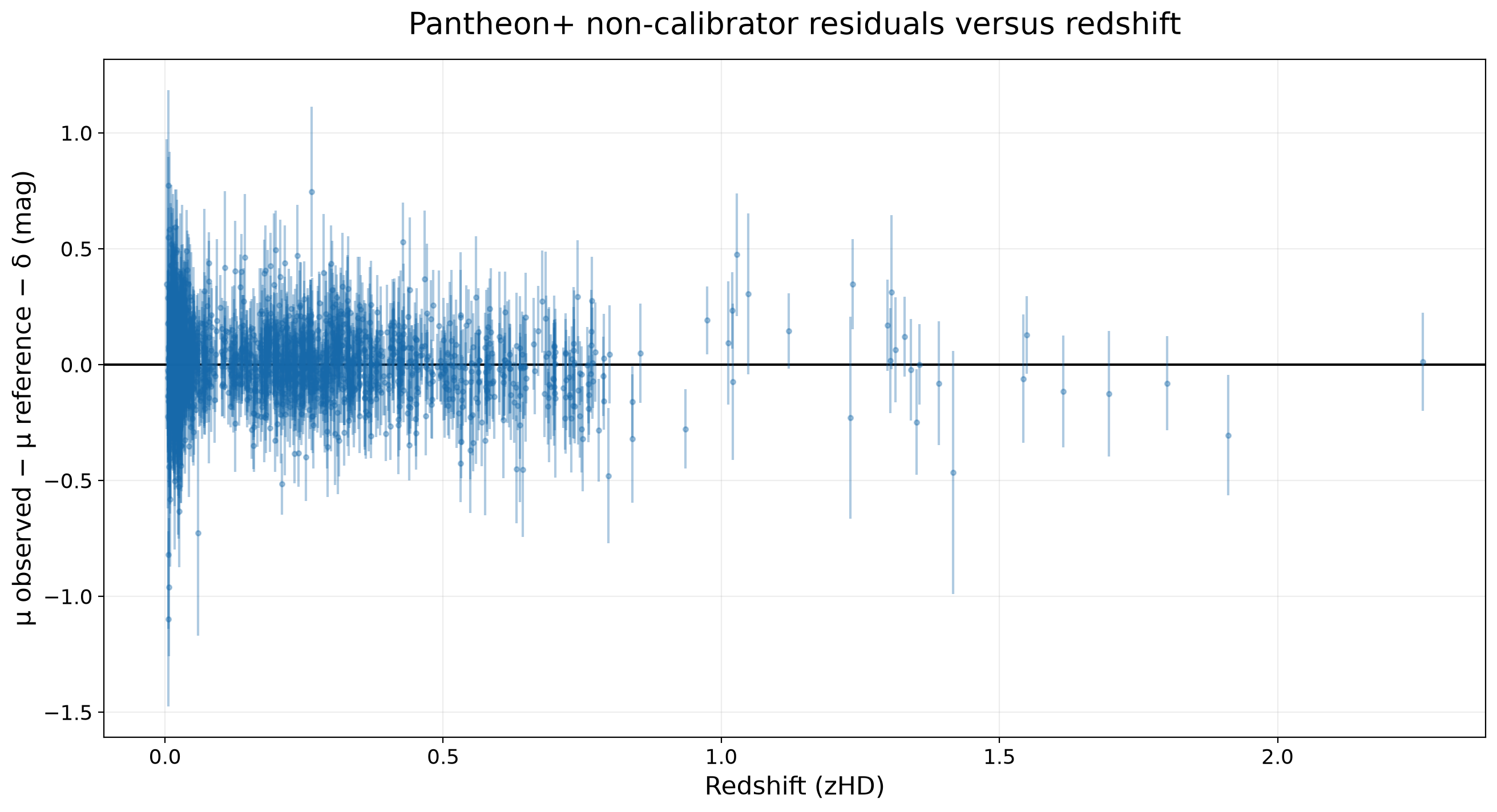
The population analysis supports a full STAT+SYS precision-matrix fit for DES-Dovekie and a full STAT+SYS covariance fit for the Pantheon+ non-calibrator subset.
Evaluation
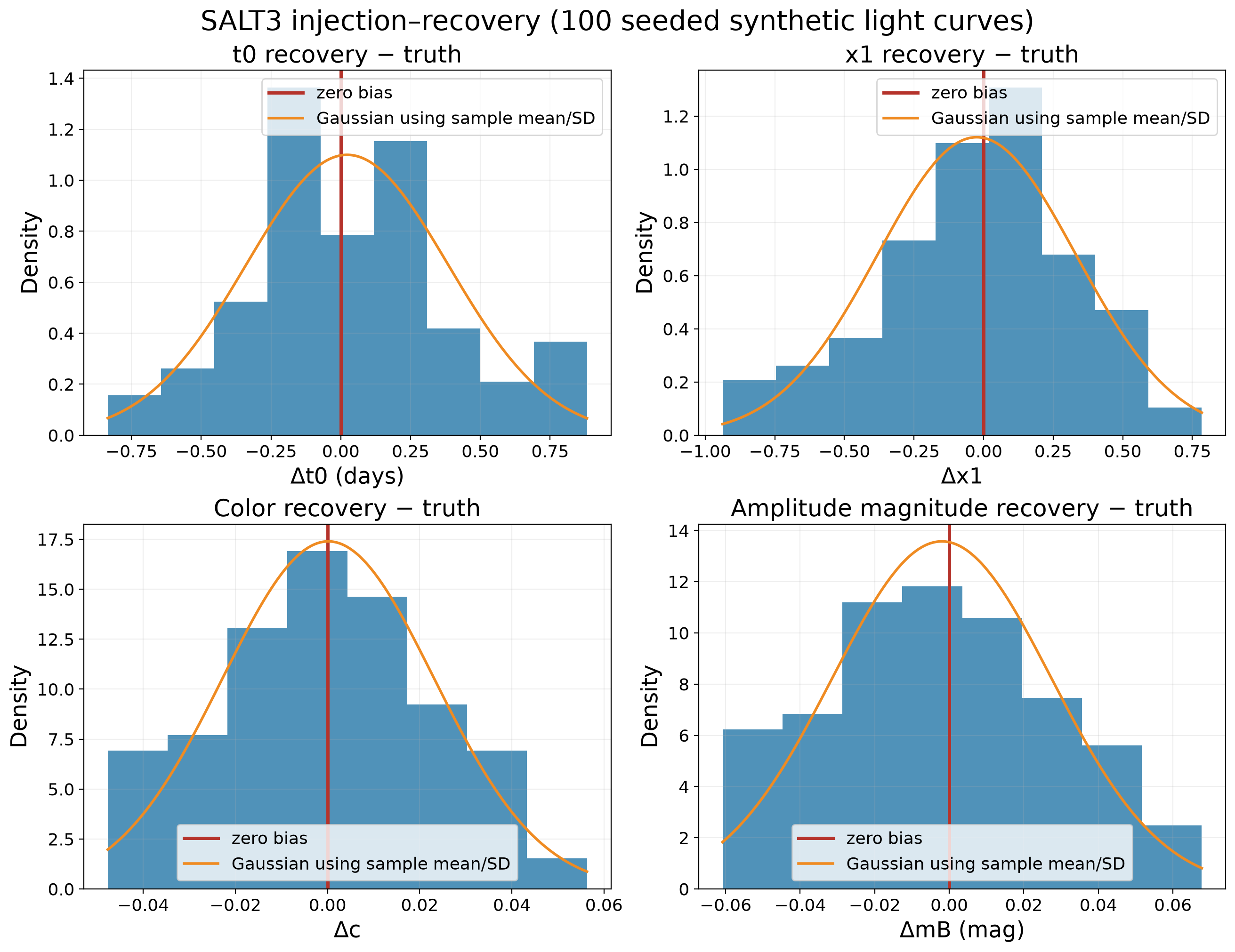
The verification run used a fixed-seed set of 100 synthetic SALT3 injection fits. The program's own SALT3 fitter converged on all 100 under the bundled cadence and noise model.
The catalog checks used the supplied public release files and their aligned full matrices. An independent Pandas/NumPy script recomputed the headline values without importing the project package.
Key findings
All 100 of 100 synthetic injection fits converged under the report's own fitter. This is a software check under the bundled cadence and noise model, not a survey-performance or truth-within-one-sigma claim.
For each of the four reported quantities (t0, x1, c, and mB), the absolute mean offset was smaller than its sample scatter in this fixed-seed synthetic run.
The DES-Dovekie full precision-matrix analysis contains 1,820 release rows. The Pantheon+ full covariance analysis contains 1,624 non-calibrator rows.
The independent raw-file recomputation reproduced the reported catalog statistics to every printed digit; the largest listed absolute difference was 4.19×10⁻¹¹.
My role and the agent workflow
I built the analysis workflows and reviewed the scientific assumptions, matrix handling, and limits of each result.
Claude and Codex assist with bounded research and implementation tasks. I review their output and ran the verification and independent recomputation before publishing these claims.
Limits
The app is an educational single-object and descriptive catalog-analysis tool. It does not infer H0 or cosmological parameters, build a joint likelihood, or test cosmological tension significance.
The injection check uses the bundled example cadence and noise model. A successful fit is not a claim of survey performance.
The two catalog row counts describe separate released samples and are not added or presented as unique supernovae.
The illustrative sample redshift and standardization constants are demonstration assumptions, not external measurements or survey calibrations.
Evidence and reproducibility
The 2026-11-06 report and summary record 281 offline tests passing and 9 integration tests passing on the 1.0.1 maintenance version, with all required local data paths supplied. The report is in reports/verification_2026-11-06 of the public repository; the official catalogues are not redistributed.
The same report includes the injection-recovery result, independent raw-file recomputation, and the public-data result plots shown here.